
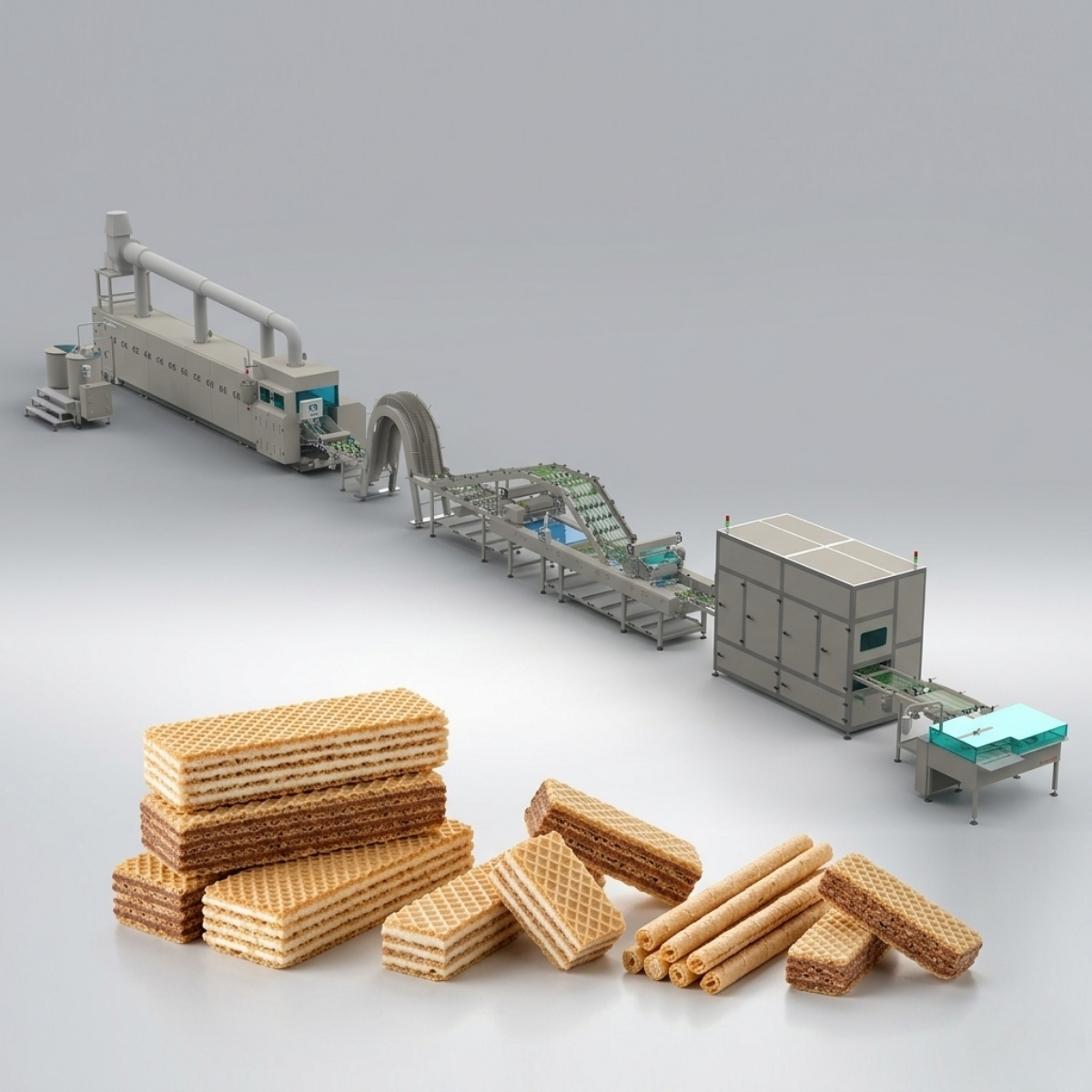
Wafer Production Plant: High-Capacity Manufacturing with an Industrial Wafer Production Line
Discover high-capacity, automated, and efficient manufacturing processes powered by industrial wafer production lines. Learn about wafer production systems, plant components, capacity planning, and key investment considerations.
Explore Wafer Production Plant Solutions
What Is a Wafer Production Plant?
A wafer production plant is a fully automatic industrial manufacturing system that covers wafer-sheet baking, cream preparation, spreading, layering, cutting, and packaging.
These integrated systems standardize production processes, maintain consistent product quality, and enable high-capacity manufacturing.
How Does the Wafer Production Process Work?
1. Batter Preparation
Flour, water, and other ingredients are measured by automatic dosing systems and mixed to prepare the wafer batter.
2. Wafer Sheet Baking
The prepared batter is baked into thin sheets in high-temperature wafer ovens. This stage plays a decisive role in the product’s crispness and texture.
3. Cream Preparation
Cream fillings can be prepared in flavors such as chocolate, hazelnut, and vanilla to support a diverse product range.
4. Cream Spreading and Layering
Automatic systems spread cream between the baked wafer sheets to create a uniform multilayer structure.
5. Cooling and Conditioning
The layered wafer blocks are stabilized in cooling tunnels before cutting.
6. Cutting
Large wafer blocks are cut into standardized dimensions using automatic cutting machines.
7. Chocolate Coating (Optional)
Wafers can be coated with chocolate to produce higher-value product variants.
8. Packaging
Finished products are packaged under hygienic conditions and prepared for distribution and sale.
Main Components of a Wafer Production Plant
- Batter preparation system
- Wafer baking oven
- Cream preparation and storage tanks
- Cream spreading system
- Cooling tunnel
- Wafer cutting machines
- Chocolate coating system (optional)
- Automatic packaging machines
Advantages of Industrial Wafer Production Lines
- High production capacity: The ability to manufacture several tons per day
- Consistent quality: Uniform product quality across every production cycle
- Lower labor costs: Fully automated production processes
- Flexible production: Support for different fillings and product varieties
- Energy efficiency: Optimized manufacturing processes
Production Capacity and Performance
Depending on the selected configuration and capacity, industrial wafer plants can produce between 1 ton and more than 10 tons per day. This provides a major advantage for manufacturers operating at high production volumes.
Who Uses Wafer Production Plants?
- Confectionery manufacturing plants
- Export-oriented food manufacturers
- Private-label manufacturers
- Large-scale food factories
What to Consider When Setting Up a Wafer Production Plant
- Machine quality: Stainless-steel construction and hygienic design standards
- Automation level: PLC-controlled production systems
- Capacity planning: Output aligned with the target market
- Product flexibility: The ability to manufacture different wafer varieties
Investment Potential and Profitability
Wafer production is an attractive investment area due to high consumption volumes and strong global demand. Fully automatic production lines can provide:
- Lower product waste
- Faster production cycles
- A potentially shorter return-on-investment period
Conclusion
A wafer production plant is a strategic investment for companies aiming to manufacture at high capacity. With the right engineering approach and correctly selected equipment, manufacturers can improve efficiency, maintain consistent quality, and build a strong competitive position in global markets.
👉 Explore professional wafer production solutions:
Discover Wafer Production Plant Systems